
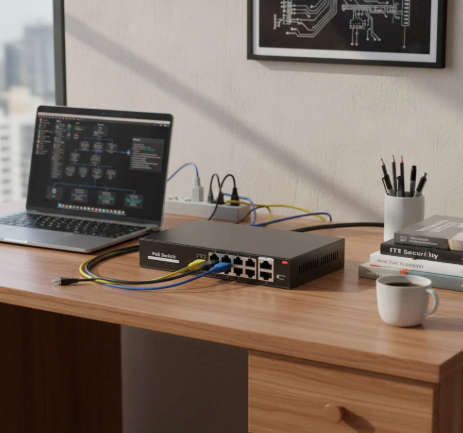
The typical factory security system is a tangle of cameras, scanners, wireless APs, and machine-vision systems all competing for a few power outlets. Network drops can be common as smart factories add new devices faster than electrical rooms can adjust to. As manufacturers add more equipment, simply adding more power outlets and network cabling can increase infrastructure complexity, installation costs, and maintenance demands.
A Power over Ethernet (PoE) managed switch delivers both power and data over a single Ethernet cable, giving teams the visibility and control unmanaged “plug-and-forget” switches cannot. For PoE smart factories, the benefits can include:
- Simplified installation
- Centralized control for power and network management
- Better traffic management and segmentation
- Reliability in harsh conditions
- Lower Total Cost of Ownership (TCO)
Unlike conventional office networking equipment, PoE industrial managed switches are built to withstand the heat, dust, vibration, and 24/7 operation of smart factories.
What is a PoE Managed Switch?
PoE is the technology that allows power and data to be transmitted to connected devices (CDs) via one Cat5e/Cat6 Ethernet cable. It enables the operation of CDs like IP cameras, sensors, access points, and some lighting without the need for a localized outlet.
A managed PoE switch adds network and power-management capabilities. A managed PoE switch lets operators see all ports, set priorities, schedule or reboot power remotely, segment traffic, and get real-time alerts all while optimizing energy usage. Network downtime is minimized or eliminated altogether across critical devices. While an unmanaged switch may be cheaper, it offers no visibility and is a poor fit for mixed informational technology (IT)/operational technology (OT) traffic. A managed non-PoE switch provides control, but no power on the cable. A PoE managed switch handles both.
High-power PoE adheres to the IEEE 802.3bt standard, offering up to 90W of power per port.
Smart Factories Put Extra Pressure on the Network
Smart factories drain network power. Devices like ceiling cameras, AGV (Automated Guided Vehicle) Wi-Fi, line-side sensors, and quality inspection cameras are dense and often located far from electrical panels. Security control traffic like motion sensors and Programmable Logic Controllers (PLCs) can’t wait behind a firmware download or 4K video stream. Temperature fluctuations, Electromagnetic Interference (EMI), surge events, and vibration in harsh environments are hard on electronics. When layouts change, rewiring AC is expensive and time-consuming.
The convergence of IT and OT onto a single, shared Ethernet fabric makes strict network security and logical traffic segmentation paramount. A factory-grade PoE managed switch sits at that intersection for smart factories.
The Benefits of a PoE Managed Switch for Smart Factories
A managed PoE switch serves as the operational backbone of a smart factory, delivering the power, control, and resilience needed to keep modern automated production running without interruption.
Faster, Cheaper, More Flexible Deployment
Consolidating power and data into a single Ethernet cable, managed PoE switches streamline factory infrastructure. Eliminating the need for dedicated electrical conduits, outlets, and licensed electricians at every endpoint means network technicians can quickly mount or reposition equipment whenever a production line layout shifts.
This one-cable approach easily accommodates high-draw industrial hardware including:
- Machine vision systems
- PTZ surveillance cameras
- Wireless access points for AGVs
- IIoT condition sensors
SFP (Small Form-factor Pluggable) fiber uplinks bridge long distances back to central control cabinets. Hardened solutions like Versa’s D60-084-90 feature eight 90W PoE ports within a compact chassis, letting teams power demanding devices directly off a single unit without compounding installation costs.
Centralized Power Management
A managed switch gives operators full control over power delivery right from the cabinet. Central dashboards display real-time per-port consumption against total power budgets allowing administrators to set power priorities that keep safety systems operational during heavy loads. If an access point or camera freezes, the port can be power-cycled remotely to restore service instantly. Additionally, automated power scheduling allows non-critical loads to power down during off-hours, offering a simple way to trim energy costs and support plant sustainability goals.
Built for the Industrial Edge
Factory environments can expose networking hardware to conditions rarely encountered in a conventional office.
Office-grade switches fail quickly when exposed to the harsh realities of the factory floor, where a single hardware failure can take down cameras, sensors, and wireless coverage simultaneously. Industrial switches are engineered specifically for line-side environments, featuring wide operating temperature ranges (typically −40°C to 75°C), high surge protection (such as 6 kV on PoE ports), dual DC inputs, and rugged DIN-rail housings. For plants operating under strict procurement rules or government-adjacent contracts, selecting TAA-compliant, industrial-grade hardware ensures long-term operational resilience where standard IT equipment simply cannot survive.
Protecting Critical Production Data
By combining advanced management features with standard Ethernet networking, managed PoE switches balance the precise traffic needs of plant operations with traditional IT visibility. Virtual Local Area Networks (VLANs) segment heavy video streams and general wireless traffic away from critical OT (Operational Technology) control communications, while Quality of Service (QoS) guarantees time-sensitive data receives top priority. Network redundancy protocols, such as Spanning Tree or ring topologies, protect production cells by keeping data flowing even if a cable is cut. For facility managers, features like ONVIF discovery on models like the D60 series streamline the deployment of surveillance hardware used in quality control, while SNMP monitoring allows corporate IT to maintain full visibility across the entire plant floor.
This is useful for facilities that incorporate surveillance into quality and safety, not only security.
Security and IT/OT Convergence
As IT and OT networks merge into a unified fabric, managed switches provide essential security boundaries without requiring duplicate physical infrastructures. Administrators can disable unused ports, apply MAC address binding, and control user access to prevent unauthorized hardware from connecting to the network. Centralized logging and authenticated management replace the security blind spots of unmanaged hubs, delivering necessary network hygiene and maintaining clear boundaries between production zones and corporate systems.
Lower Total Lifetime Cost
While industrial managed switches require a higher initial investment than basic hardware, the alternative can be much more costly in the form of downtime, electrical recabling, electricians, and emergency maintenance. By eliminating dedicated power runs, simplifying line changeovers, and avoiding expensive site visits to reset frozen endpoints, managed switches pay for themselves quickly. Rugged construction ensures a longer service life, making the upfront cost of factory-grade PoE small compared to years of avoided electrician fees, power adapters, and unplanned line stops.
The D60-084-90 Managed Switch from Versa Technology
The D60-084-90 Managed L2 Industrial PoE Switch directly addresses smart factory demands without the need for additional cables.
Key features include:
- 8 x 90W IEEE 802.3bt PoE++ plus extra GbE/SFP uplinks
- 480W PoE budget
- Layer 2 managed: VLAN, QoS, SNMP, loop protection
- -40ºC to 75ºC operating temperature
- 6kV PoE surge protection
- ONVIF camera discovery/topology tools
- TAA compliant
Note that industrial units typically ship without a power supply, so the appropriate industrial power supply should be selected according to the deployment’s requirements.
Building Smarter Factory Networks With PoE
Smart manufacturing does not necessarily require adding separate power infrastructure every time another connected device reaches the factory floor.
The smart way to operate a smart factory is with PoE. Modernizing your network starts at the end of the line, not with a costly rip-and-replace. By combining simplified cabling, remote power management, and factory-grade traffic control, operations are instantly stabilized with a PoE managed switch.
Map the cameras, APs, and sensors you have on one cell then contact Versa Technology to browse industrial PoE managed switches. Working within your budget and temperature range, we can help you determine the number of ports and the wattage you need for your application.